Thank You to Everyone Who Attended our 2025 Symposium | Keep Up With Future CLC Events
“The job of the writer is to make revolution irresistible.” – Toni Cade Bambara

Lia Wu is half-Chinese, wholly ADHD, and hopelessly nerdy. She taught middle and high school English for three years, then was called crazy when she told her students she missed writing essays and that she was going back to graduate school. She earned her BA in English, Asian Studies, and Classical Studies at Rice University and her MA in publishing at Western Colorado University. Somewhere in there, she also earned a graduate certificate in Homeland Security and Defense from Missouri State University. She is now currently living in Arkansas where she's aiming to earn her PhD in English with a focused study in Rhetoric and Composition and an emphasis in World Literatures and Cultures (which is just a really fancy way of saying that she's like a Pokemon trainer - gotta study 'em all!) Reading and writing is her passion, hence her work with local authors through her publishing company, Ozark Hollow Press. She has published two short stories: "Tail-End" in the anthology Feisty Felines and Other Fantastical Familiars and "The Ties That Bind" in the anthology Chaotic Cupids: When Love Goes Awry.
Script
My name is Lia Wu and I am a 2nd year English PhD Candidate with the University of Arkansas. Today, I will be speaking to you about how acts of reading and writing our visions of utopia are themselves acts of resistance. I bring this to you because earlier this summer, I woke up to several headlines announcing the increased pressure to criminalize female authors in China for the content they were writing about. This, unfortunately, is not a new development. However, it is also not an issue that is talked about enough. I wish to emphasize here that this is an issue that affects everyone. In doing so, I also want to emphasize that, while this is concerning and effects all of us, it is not a hopeless situation.
The following presentation will include audio voiceovers of myself guiding you through the material, video clips, and accompanying images. Feel free to progress at a pace that is comfortable with you. When you are ready to proceed, scroll down to start the next audio recording.
First, let’s talk about Danmei as restorative resistance.
“Danmei”, meaning “obsession with beauty” in Chinese, is a genre coming out of the popularization of “boys’ love” (BL, yaoi) content in Japan and centers stories revolving around male-male romantic and sexual relationships. The overarching narrative around this genre, particularly as it pertains to Chinese audiences, is that it is a genre produced by “straight women for straight women” (Zhao). Within this context, danmei readers refer to themselves as “rotten women”, nodding to the Japanese use of the term “fujoshi”, translated as “rotten girl” (Sullivan). Positioned in this way as a female-generated and female-supported industry, the genre is considered by the state to be a “lowbrow deviation” from other genres and is qualified as an “internet fiction genre” (Ip). The identity of the authors and consumers as female is intrinsically tied to the genre in the same breath as this genre is delegitimized by the greater community. I would even take a step further and argue that the genre is delegitimized because of the female-centered identity of its creators and readers.
Feminist scholars and advocates argue that danmei is a very feminist genre, allowing women to escape the realities of a patriarchal society that “discourage[s] women from expressing and enjoying sexual desires” (Zhao) and to explore female-perspective ideals of the male body (Sullivan). Devaluing this genre, the state then turns to monitoring, controlling, and criminalizing it. The Chinese Communist Party has pressured publishers and online platforms to take down or heavily adapt danmei-related material. TV studios, when adapting danmei texts for the screen, must remove the romance element between the male characters and instead position it as a relationship of “socialist brotherly love” (Sullivan). Authors write under pseudonyms for safety, but many authors have still been jailed, serving multiyear sentences on pornography charges (Sullivan).
Within this sort of atmosphere, I would even argue that danmei might not even be a genre “by straight women for straight women” in China, but that any other-identified readers must remain unseen as consumers for the sake of remaining safe. This suspicion bears weight when one observes the shift in audience composition once you include Western countries, where many note there is a heavy queer readership.
Considering this context, it is not difficult to see how danmei, as a genre, and the consumption of it is positioned as “resistance”. However, I want to take a step further and argue that danmei is, in fact, restorative resistance. Japanese feminist Chizuko Ueno asserts that danmei characters are “neither male nor female, embodying instead an idealised ‘third gender’” (Sullivan). Authors and readers are thus able to find in these androgynous bodies escape from strict gender norms and institutionalized expectations of gender roles in the workplace and in the home. In this way, danmei readers and writers can engage in the survival literacy practice of fictive kinship, seeking comfort and validation in the identity, image, and actions of such characters where they are unable to in the “real world”. Further, writers and readers utilize and engage with chronotopes in order to oppose delegitimization and censorship.
As written texts, danmei novels, Zhao notes, “harken back to some of the most well-known classics in Chinese fiction, […] many of which were based on the scripts, known as huàběn 话本, of serialized oral storytelling performances that were popular in the Song dynasty in the 10th century.” Structurally, then, danmei stories utilize the norms of state-recognized and state-promoted “traditional” texts. Beyond structure, Zhao continues, this genre has likewise “revived, after nearly a century of suppression, the writing of eroticism, especially same-sex eroticism, that was integral in classics […] and continued the aesthetics for male beauty celebrated in classical poems as old as those in The Book of Songs (诗经 shījīng), dating back to the 11th century BC.” In this way, danmei novels implement the chronotopes of “legitimate” texts, thus reclaiming legitimacy and cultural identity within their own contexts and purposes of creation and consumption.
Let’s turn now to a case study:
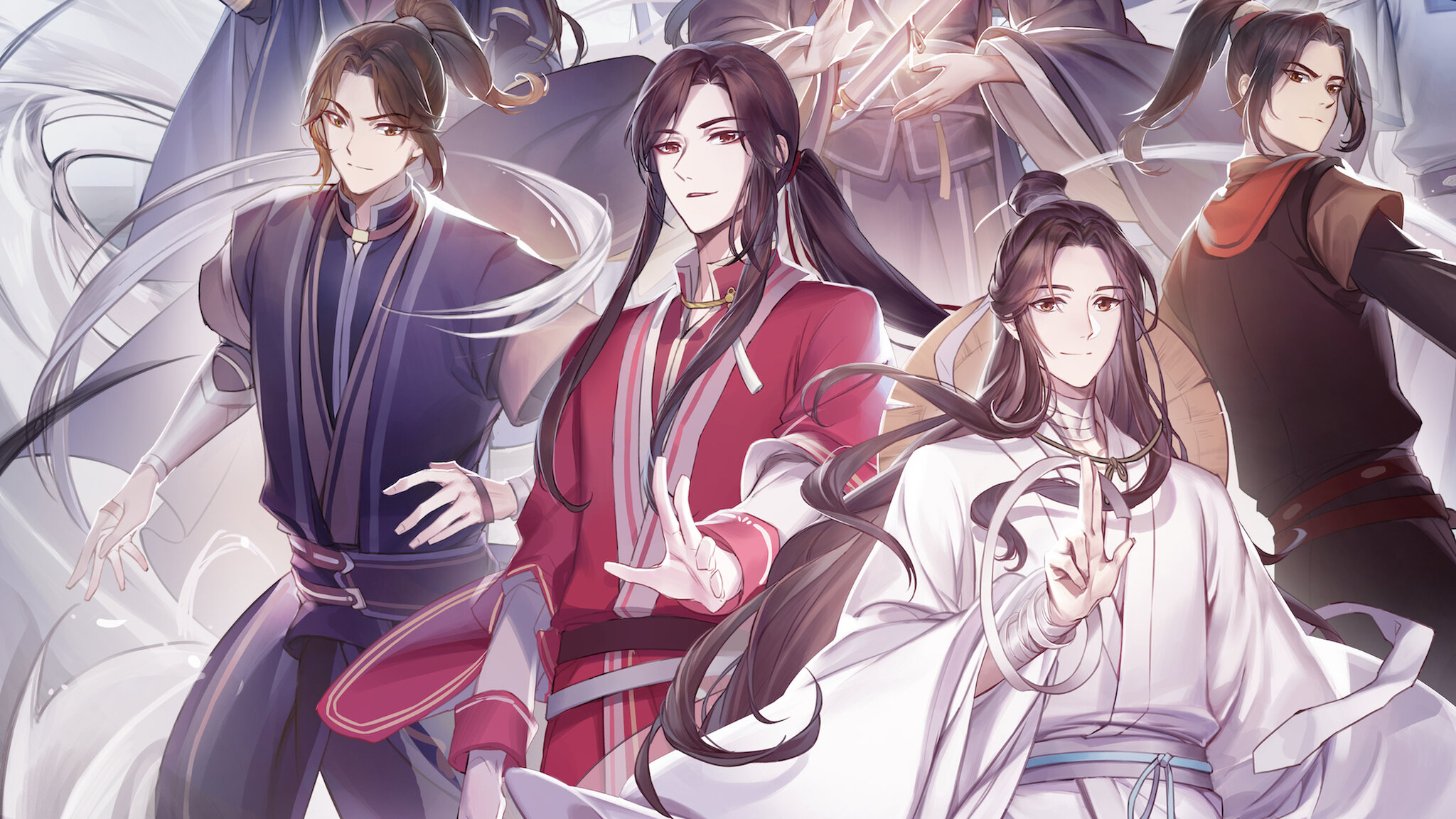
Grandmaster of Demonic Cultivation is a danmei series by Chinese author Mo Xiang Tong Xiu. Examining the donghua adaptation of Grandmaster of Demonic Cultivation, we see how chronotopes are used to circumvent censorship, thus pointing to the multimodality of survival literacies.
Watch the following video clip. Once you’ve finished, proceed to the next audio recording.
Separately, the two moments you just watched are, respectively, an exciting action sequence and a somber reflection on past events. Audience members familiar with traditional wedding ceremonies, however, excitedly noted how the red robes and bows before family were strongly indicative of a marriage. Reviews and posts about these scenes talked about “the marriage robes” and “the wedding”, expressing astonishment that the producers of the show had managed to sneak these moments past Chinese censorship. Further, many viewers emphasized how Lan Wangji’s dialogue of “I’ll accompany you”, wǒ péi nǐ (我陪你) in the Chinese, carry the emotional register or connotation of an informal marriage proposal, as péi 陪 holds a much more intimate and emotional heft than wǒ gēn nǐ qù (我跟你去), which translates similarly as “I’ll follow you”. In this way, remaining “unseen” and resting on the shared cultural memory of the Chinese people, the donghua was able to nod to the chronotopes of traditional marriage ceremonies and turns of phrase to sneak a more romantic connotation into the relationship between the two main male characters. Thus, the original dynamics and values of the written text were allowed to survive even under the scrutiny of state censorship. This enacts the disruption of erasure within counterstories. While these stories as fiction generate out of and are located within more of an imagined utopia, rather than experienced reality, of marginalized voices, the fact remains that the act of writing and consuming these stories allows women, straight or otherwise, and other queer voices to find representation, community, and validation within the context of a censorial and patriarchal society that seeks to devalue, restrict, or silence them.
Let’s transition now from restorative resistance to restorative imagination. To do this, I will direct you to the genre of light novels. Coming out of the pulp magazine tradition of the 1970s and 1980s, this is a predominantly Japanese style of writing and publishing that many consider “mass-produced and disposable” (Morrissy). Rather than following a set of standards in terms of content or focus as expected of a shared genre, light novels instead utilize similar production methods and mixed media modes. As technology and reader bases have evolved, many light novels have begun to release as web novels or serialized chapter installments on online platforms. Targeting primarily teen and young adult readers, such texts are considered “light” reads, hence their eponymous category. While not as overtly dismissed as the danmei genre is, light novels are still discussed on blogs and writing platforms as something “females gravitate towards”, presumably, if one blogger is to be believed, because “they are easy to read” and “the vocabularies used in writing are simple and easily understood”. The same blogger posits that, in contrast to light novels, “[traditional] novels usually target intellectual people” (Harris). In this way, then, we again see a devaluing of a category of writing and reading in association with a female-dominant audience. At the same time, publishers see light novels as very lucrative, especially in relation to their potential for anime adaptations. Thus both devalued and monetized, the light novel medium exists at a similar socioeconomic crossroads as the danmei genre.
Let us now explore a case study of restorative imagination. Japanese female author Natsu Hyuuga first serialized The Apothecary Diaries on the website Shosetsuka ni Naro in 2011. It has since been picked up by multiple publishers and has had successful manga and anime adaptations. Rather than shifting the production process of her story to be more “legitimate” throughout this story of success, Hyuuga has insisted on maintaining her serial release format of the story’s origin. She gauges reader responses and adjusts her writing accordingly, leading readers to assert they “[feel] like their voices matter” and that she “[treats] them as collaborators” (Diffey). This is an act of restorative resistance and imagination, allowing readers to not only define themselves through observing, but also literally through defining the characters and story.
Turning to the anime adaptation of this text, multimodality opens up an avenue to aggressively highlight, and consequently queer, traditional gender norms, particularly surrounding beauty. Further, the light novel and anime both utilize the setting of Tang dynasty imperial China to set up a restrictive environment surrounding gender and social class that the characters then navigate, negotiate, and complicate such that chronotopes are implicitly employed to comment on ongoing struggles females face in modern Japanese society[1]. More explicitly, the chronotopes of “traditional” imperial Tang dynasty Chinese customs are used to directly challenge gender norms and roles. This plays out in a variety of ways in the text.
Watch the following video, then when you are ready, move on to the next audio recording, where I will walk you through the visual modality of anime and the chronotopes of imperial China as they relate to our purposes here.
In the video you just watched, Jinshi, dressed as a woman and superimposed upon the memory of a female dancer, forms a Vitarka Mudra with his hand. This gesture itself includes a whole host of connotations, literature, and history as tied to Buddhist practice and teachings. However, in its simplest, purely visual implementation, it is commonly associated with female divinity or noble female performativity in TV shows, movies, stage plays, and other visual media. In this way, as one reviewer notes, “Jinshi doesn’t perform traditional masculinity […] [r]ather, he performs femininity with his elegant dress and posturing” (Vargas).
Set within an imperial court where class and gender roles are strictly delineated and enforced, the text thus appeals to the chronotope of the eunuch in imperial China to show moments where characters deny, oppose, or challenge “traditional” gender norms and, through doing so, experience success, wherein writer and readers are able to engage in gratifying moments of restorative imagination.
In crafting a counterstory wherein the characters deftly challenge or queer gender and beauty norms within an environment that strictly enforces them, Natsu Hyuuga allows herself and readers to engage in a critique of these norms. Through this, the often-marginalized narratives surrounding gender performance can be seen and celebrated. Thus, the collaborative writing and reading of The Apothecary Diaries becomes a communal act of restorative imagination.
I would be remiss if I did not also highlight the ways in which these two texts portray and comment on literacy normativities within their own stories, demonstrating a more manifest realization and understanding of the power of literacy and survival literacy strategies on the part of the authors and readers of these stories.
First, let’s return to Mo Dao Zu Shi by Mo Xiang Tong Xiu. Examine the following image and watch the accompanying video, then when you are ready, move on to the next audio recording where I will explore the implications of the moments you will have just watched.
We see Wei Wuxian confronted with the enforcement of a “right” way of doing things that has actually been carved into stone. When he explores deviating from this way of thinking, he is severely punished, with his teacher literally “throwing the book” at him, then making him copy the rules repeatedly in order to “learn what natural morality and law is” (chapter 14). We also see that multiple voices are, within this context, suppressed or discouraged under the banner of being “unorthodox”. All told, then, we see the enforcement of literacy normativities upon the main character in unforgiving and authoritarian ways, thus demonstrating to us that Mo Xiang Tong Xiu was likely fully aware of the harmful implementation of literacies against students and nontraditional bodies or ways of thinking. Yet, we also see Wei Wuxian use modes of literacy to his advantage, reframing or otherwise queering literacy normativities as modes of (literal) survival literacies. Thus, author Mo Xiang Tong Xiu seems likely to have actively recognized the power of literacy as both a restrictive and liberating tool.
In The Apothecary Diaries, literacy or, more ostensibly, the absence of literacy is a key recurring factor in the plot. Watch the following video, then when you are ready, move on to the next audio recording where I will share other moments from the anime and text and explore the consequences of these scenes.
The video you just watched highlights a moment where Natsu Hyuuga and her collaborative reader base acknowledge the power of literacy and crafts a world where the characters strive to reduce the class and gender barriers to that power. Further, by having the texts that are distributed be those based on the knowledge of brothel women and produced by those same women, we see the legitimization of alternative literacies.
However, the text also acknowledges an element of danger in possessing the “wrong” literacy and aims to critique the implications of suppressing this “wrong” literacy. In volume three, Jinshi and his attendant Gaoshun tell Mao Mao that only men are allowed to be doctors and, therefore, only men are allowed to make the drugs and medicines necessary to treat any illnesses the concubines, ladies in waiting, or serving girls might experience. They reassure Mao Mao that they are turning a blind eye to her own actions of creating medicine, but that they are unable to do the same for the women who run the rear palace clinic. Coupled with the fact that the man employed as the apothecary in the rear palace is unskilled and regularly referred to as a “quack doctor”, the women in the clinic are left with few options and only able to use alcohol as a disinfectant and to provide a clean place for people to rest and quarantine themselves from the rest of the rear palace. In this way, we see the author acknowledge the norms and pressures surrounding access to certain literacies by certain demographics and aim to highlight ways in which this restriction negatively impacts women’s health of all social classes.
This active engagement with literacy is not isolated to these texts alone, as many other danmei and light novels aim to similarly do so, such as The Scum Villian’s Self-Saving System and Violet Evergarden. With this in mind, I argue that the implementation of survival literacy strategies like fictive kin, chronotopes, multimodality, and counterstories is purposeful, utilized by authors and readers as active agents for the sake of critical restorative resistance and imagination.
In bringing this project to a close, I first wish to acknowledge that there are many things I left undiscussed in regards to East Asian sociopolitical climates, cultural and literary mores, relevant plot points, modalities and survival literacies situated within the source texts and the adaptations. There is a lot left to explore, including depictions of disability and age in the texts treated with here. In the immediate context, I hope that I have opened a new dialogue. Of particular note in this exploration is the very pressing issue of devaluing genres and publication technologies that are closely associated with female and queer authors and readers. Therein, these individuals have successfully utilized survival literacies, but they must still navigate marginalized and criminalized modes of literacy intrinsically tied to their identities. I therefore call for legitimization and a serious engagement with these marginalized texts, for a continued appreciation of the deft and purposeful survival literacy strategies authors and readers in this atmosphere utilize, and for an appreciation of the restorative resistance and imagination of writing and reading utopias that don’t quite fit the status quo.